The Harvard/MIT
Astrobiology team comprises a diverse group of microbiologists, dynamicists,
paleontologists, sedimentary geologists, geochemists, and planetary
geologists. Our interactions are rooted in the common goal of understanding
the co-evolution of life and environments in Earth history. The focus
of our team is on integrated field, laboratory-based, and theoretical
investigations interpreted in the context of insights drawn from comparative
biology and research on contemporary geological and biogeochemical
processes. Our research on the co-evolution of Earth and its biota
is founded on a careful analysis of the rock record that accumulated
during critical intervals of biospheric change. Focal points of this
research are:
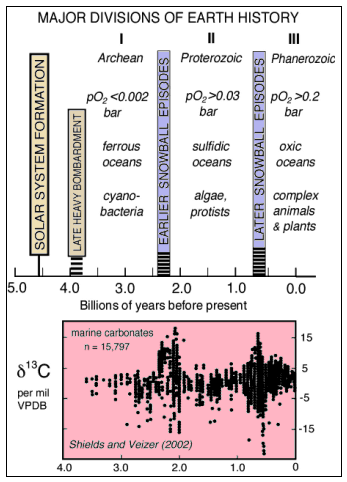
The Proterozoic (2500-543 Ma)
oxidation of the Earth's surface when ocean chemistry moved
from being anoxic and iron rich, to sulfidic to fully ventilated with
oxygen.
Neoproterozoic-Cambrian (1000-543
Ma) environmental change and evolution comprising paleontology,
geochronology, tectonics, sedimentology and environmental changes
of this period, looking for models of integrated change in the Earth
system.
The Snowball Earth Hypothesis
and the impact of extreme climate on the history of life.
The Permo-Triassic Boundary
(251 Ma) including causes and biological consequences of the mass
extinction which removed some 90 percent of Earth's species diversity
and permanently altering the course of evolution.
Molecular and isotopic approaches
to microbial ecology and biogeochemistry including isotopic
characterization of molecular biosignatures to understand the functional
and systematic relationships of microorganisms in natural ecosystems.
Geobiology of hematitic sedimentary
rocks including studies of iron-rich sedimentary rocks (Banded
Iron Formations and associated sediments) and research on Neogene
iron deposits (Rio Tinto system, Spain)
Molecular evolution and phylogeny
to understand the relationship between molecular clock and paleontological
estimates of evolutionary divergence times and deconvolute biological
from geological signals in Phanerozoic marine diversity studies.















