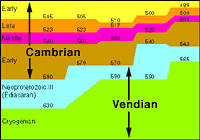
This
subproject has enjoyed the broadest participation of Harvard team members,
and for good reason. The Proterozoic-Cambrian transition witnessed remarkable
changes in tectonics, climate, atmospheric composition, and especially
life. This is the interval during which animal life -- and, hence, the
prospect of intelligence -- radiated on Earth. Harvard team researchers
are studying the paleontology (Knoll, Grotzinger, Erwin), geochronology
(Bowring, Grotzinger), tectonics (Hoffman, Bowring), and environmental
changes (Hoffman, Schrag, Bowring, Grotzinger) of this interval, with
an eye to constructing models of integrated change in the Earth system.
During the past funding year, S. Bowring has dated thin volcanic ash beds below, within, and above the Gaskiers glacial deposits in Newfoundland, finding that ashes from 8 meters below the glacial deposits to 10 meters above have ages within error of one another and cluster near 580 Ma. These are the first high-precision temporal constraints on the age and duration of a Neoproterozoic glaciation. The oldest known Ediacaran fossils lie approximately 100-200 meters above the glacials and are 575 Ma, leaving approximately 5 Ma between the last glacial deposit and the initial expansion of large animals.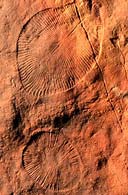
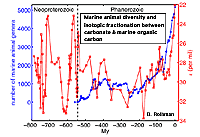 The dramatic diversification of animal phyla during early Cambrian
time has fueled debate regarding the mechanisms of early animal evolution
for over a century.
What is now clear is that intrinsic catalysts, such as the innovation
of developmental genetic mechanisms, as well as extrinsic processes,
involving environmental change, are both critically important in accounting
for this major event in the history of life. Recent attempts to delineate
potential extrinsic factors have revealed a large-magnitude, but short-lived
negative excursion in the carbon-isotopic of seawater that is globally
coincident with the Precambrian-Cambrian boundary. Possible mass extinction,
in some manner related to this negative isotope excursion, has been
invoked as a contributing mechanism that led to rapid diversification
of metazoans within restructured early Cambrian ecosystems. Research
by J. Grotzinger and S. Bowring on biostratigraphic, geochemical and
geochronometric data from Oman supports this hypothesis, indicating
an extinction of terminal Proterozoic calcified metazoans coincident
with this boundary isotope excursion ca. 542 Ma.
The dramatic diversification of animal phyla during early Cambrian
time has fueled debate regarding the mechanisms of early animal evolution
for over a century.
What is now clear is that intrinsic catalysts, such as the innovation
of developmental genetic mechanisms, as well as extrinsic processes,
involving environmental change, are both critically important in accounting
for this major event in the history of life. Recent attempts to delineate
potential extrinsic factors have revealed a large-magnitude, but short-lived
negative excursion in the carbon-isotopic of seawater that is globally
coincident with the Precambrian-Cambrian boundary. Possible mass extinction,
in some manner related to this negative isotope excursion, has been
invoked as a contributing mechanism that led to rapid diversification
of metazoans within restructured early Cambrian ecosystems. Research
by J. Grotzinger and S. Bowring on biostratigraphic, geochemical and
geochronometric data from Oman supports this hypothesis, indicating
an extinction of terminal Proterozoic calcified metazoans coincident
with this boundary isotope excursion ca. 542 Ma.
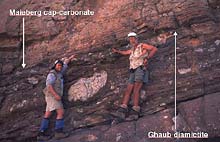 P. Hoffman continues to explore the theory, phenomenology and consequences of Snowball glaciation on the late Proterozoic Earth. Hoffman's continuing field programs focus on the geology and isotopic records of carbonate successions in Namibia, Svalbard, Morocco and Canada, that together span the critical time interval from around 850 to 530 Ma (mid-Neoproterozoic through to the Cambrian "explosion This interval includes three glacial episodes with unusual features that form the basis for snowball earthhypothesis. new tests of hypothesis are currently underway: a geochemical search interplanetary dust which predictably should have accumulated on global ice shelltargeted at newly-discovered clay layer separates deposits from post-glacial cap carbonate study boron isotopes beforeand after glaciationwhen seawater pH is predicted to been abnormally high lowrespectively: an oxygensulfur strontium isotopic primary barite seafloor cements discovered in carbonates. research complemented by analyses modeling efforts pursued team member D. Schrag. particular interest presence large negative carbon isotope anomaly just suggests methane may play role phenomena. SchragHoffman colleagues articulated novel release sediments actually cause through its interaction silicate weathering.
















)
)
)
)